Discipline 01 · Water management

Hydraulic engineering, hydraulics and water law.

Since 2004 we have been designing on watercourses in Hesse and Rhineland-Palatinate: restoring continuity, holding back floods, substantiating permits so they hold. Our clients are municipalities, water authorities, associations and operators.

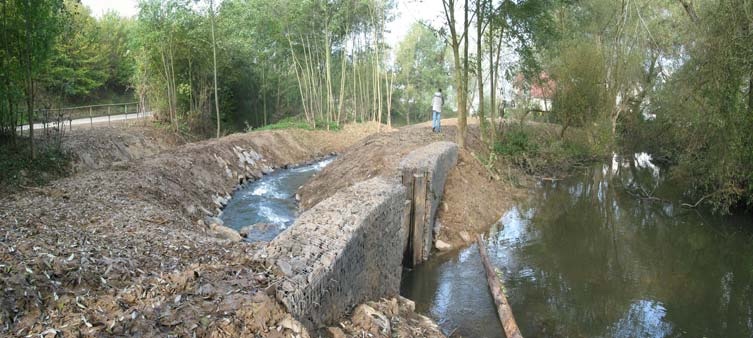
Bypass channel on the river Aar with an inlet structure of sheet piling and gabions
Service phases
1–9
complete, including tendering and site supervision
Largest design flow
53.91m³/s
Pfeiffersmühle bypass channel, Diez
Framework
EU WFD
implementing the Water Framework Directive
Region
HE · RP
Odenwald, Rhine-Main, Lahn and Aar

What we do in detail

01

River restoration & continuity

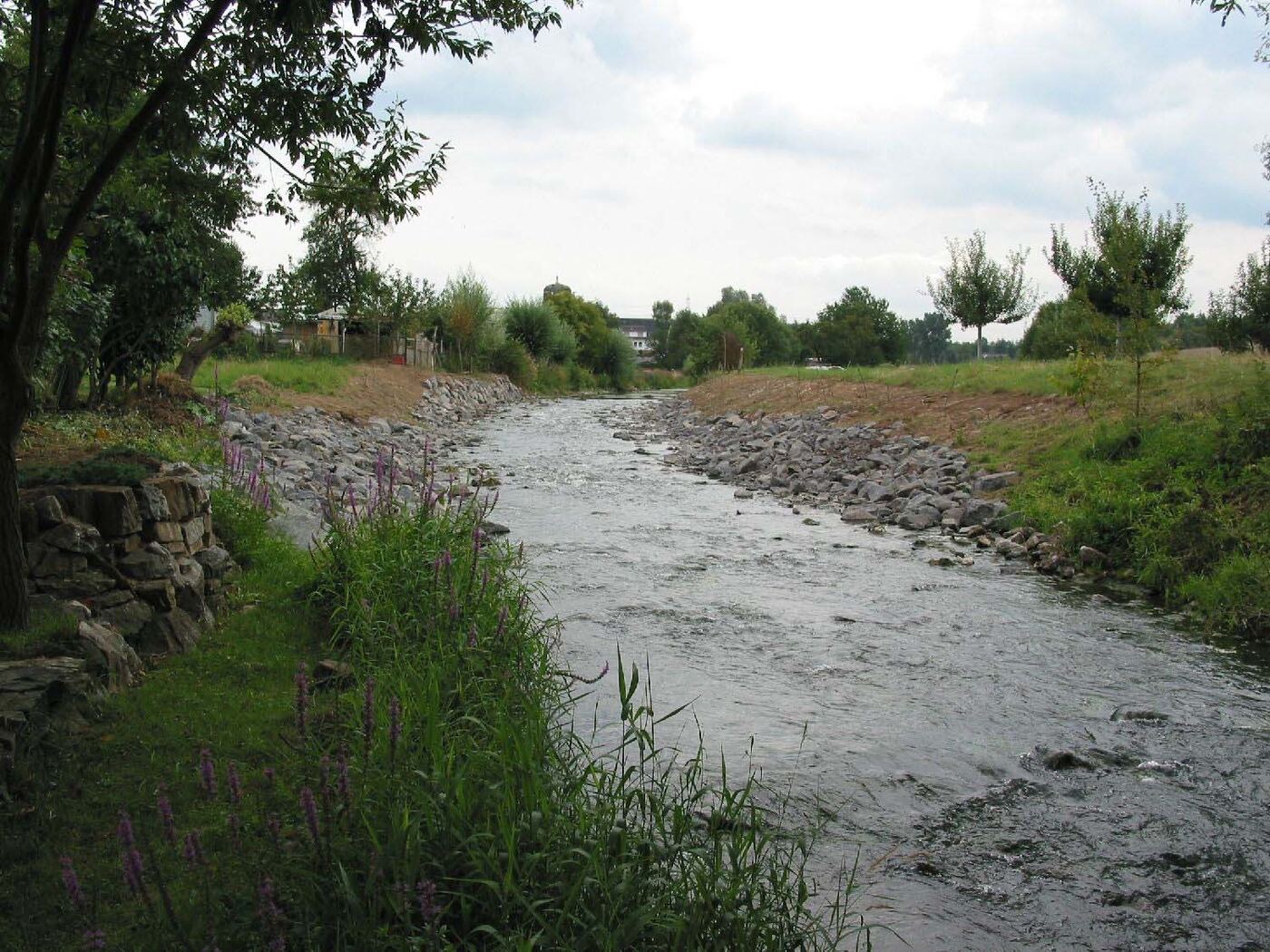
Fish passes up and downstream, rock ramps, bypass channels, conversion or removal of weirs. We first check which solution actually works at your structure – a ramp needs space and gradient, a bypass channel needs land beside the watercourse.

For municipalities usually a measure from the Water Framework Directive programme, often funded.
02

Hydraulic calculation

Discharge calculation, digital water surface profiles, rainfall-runoff. This is the maths the authority uses to justify the permit – and the basis for every dimension.

Based on our own river survey, not on data taken over from elsewhere.

03

Flood and heavy rainfall provision

Retention areas and stormwater basins, from concept through permitting to construction. With heavy rainfall it is rarely about the watercourse alone but about the flow paths through the settlement.

Hesse funds municipal provision; we deliver the auditable documents for it.

04

Water rights applications

Complete application documents for the lower water authority: explanatory report, drawings, hydraulic evidence. We know the procedure and where applications usually get stuck.

Expect several months at the authority. Starting early pays off.

05

Design across all service phases

Basic evaluation, preliminary and final design, permitting, detailed design, tendering, award, site supervision, handover and documentation.

You have one contract and one contact instead of three.

How a river project runs

  1. PHASES 1–2Survey and basics

    River survey, cross sections, as-built record of the structures, determination of the design discharge.

  2. PHASES 3–4Design and permitting

    Hydraulic evidence, comparison of options, application documents for the lower water authority.

  3. PHASES 5–7Detailing and tendering

    Construction drawings, bill of quantities, tendering, support during the award.

  4. PHASES 8–9Construction and handover

    Site supervision, setting out, control surveys, final account, as-built documentation.

What we need from you

The more of this you have, the sooner the quote arrives. If something is missing, we will tell you how to get it.

  • Name of the watercourse and the section (a map extract helps)
  • Measure sheet from the Water Framework Directive programme, if available
  • Responsible authority and contact person
  • Existing reports, surveys or as-built drawings
  • Funding programme and deadlines

Frequent questions on this

01Rock ramp, bypass channel or fish pass – which is right?

Space, gradient and the question of whether the weir has to stay decide it. If it stays (for a mill, say, or for flood relief), a bypass channel is usually the answer. If it can go, a rock ramp is the more natural and usually cheaper solution. We calculate both before we recommend.

02Do you also handle the funding paperwork?

We deliver the auditable documents for the application and the proof of use, with cost estimates in the customary structure. The application itself is submitted by the municipality – nobody can take that over.

03How long does such a project take in total?

From the first survey to handover usually one to two years, longer for larger measures. The long part is rarely the design but the permitting procedure and the construction window – work on a watercourse is normally done at low water.

Does this match your project?

Describe it in the form – three minutes. We reply within two working days with an assessment.